Research
Foundations of self-adaptive wholeness research
For polymaths, academics, researchers, therapists, and anyone interested; sensing where rigour and lived experience may meet.
Research & Development
1. Participatory First-Person Research & Quantum Resonant Linguistics
First-Person Methodology: Utilizes action research where participants serve as "experts by experience," using their own bodies as a "living laboratory" to map and translate subjective inner experiences.
Decoding Somatic Signals: Focuses on translating non-symbolic, biological signals (such as tension or pain held in connective tissues and the interstitium) into symbolic insights.
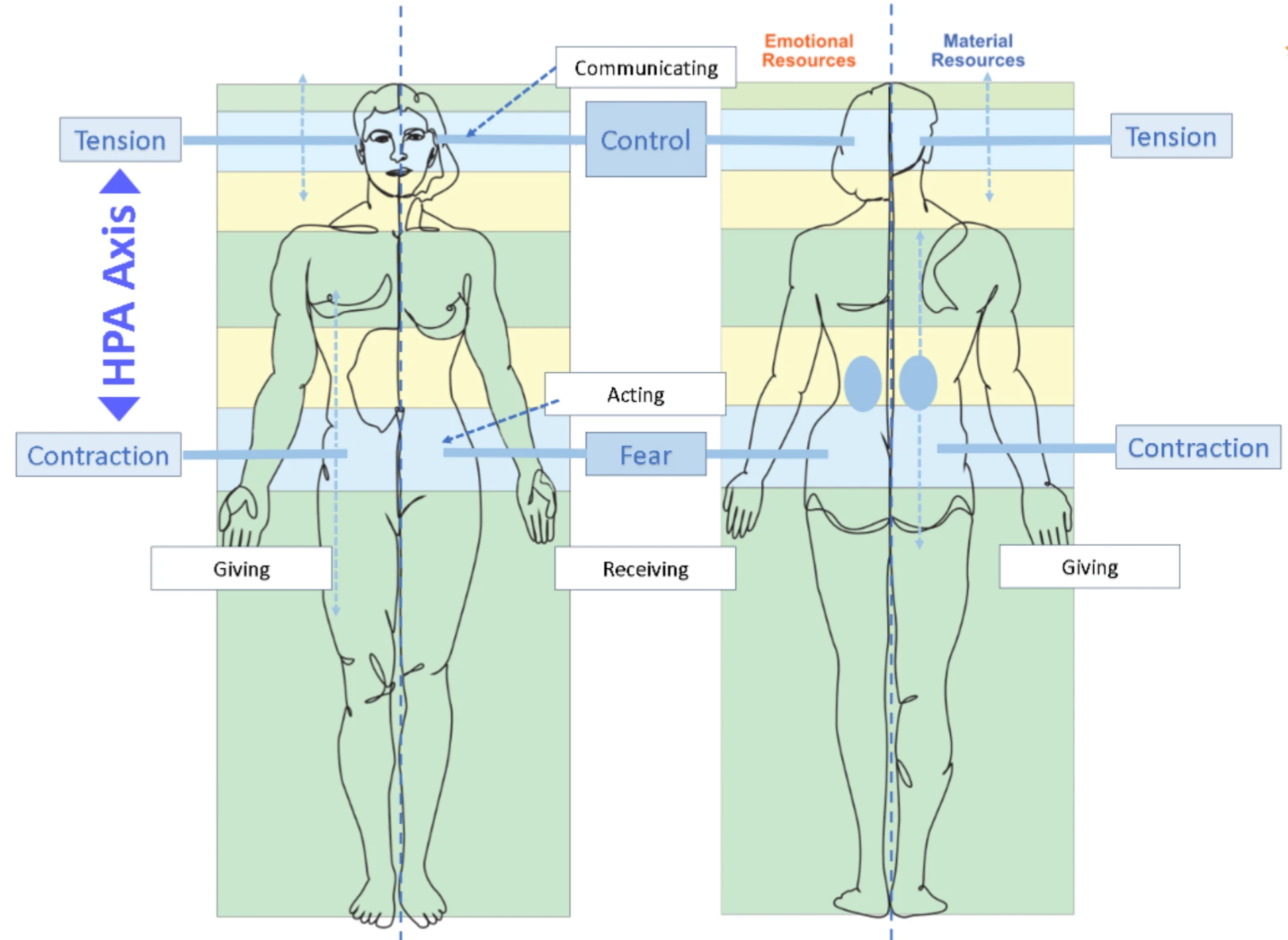
Visual Instruments: Develops and refines proprietary visual decoding tools—such as the eXperience Matrix, Body Matrix, and Mouth Matrix—to decode how unresolved emotional patterns manifest physiologically.
2. Empirical Tests of Quantum Consciousness (The G-MAC Experiment)
Brain as a Quantum System: Models human consciousness and the neuroendocrine system as a self-adaptive quantum system.
The G-MAC Experiment: Conducts the Grounding Multimodal Attention Calibration (G-MAC) experiment—a human equivalent to the double-slit experiment.
Attentional Superposition: Tests the Leggett-Garg Inequality to demonstrate that the human heart-brain system can exist in a state of "superposition," holding both selective (focused) and non-selective (open) attention simultaneously.
3. Neurophysiological and Biosemiotic Studies
Mind-Body Continuum: Integrates subjective first-person reports with objective biological data to study the physical substrates of consciousness.
Biometric Measurement: Uses quantitative tools like Heart Rate Variability (HRV), Electroencephalography (EEG), and Galvanic Skin Response (GSR) to evaluate optimal system coherence.
Fascial & Interstitial Matrix Studies: Investigates how unresolved emotional experiences project onto the body's connective tissues (fasciae) and fluid-filled interstitium.
4. HEAL-AI and EdTech Development
Quantum Resonant Corpus: Trains Large Language Models (LLMs) on a specialized "quantum resonant language corpus" (Rheomode X) to move artificial intelligence beyond current task-focused "cognitive biases".
HEAL Companion App & Cloud: Develops AI-guided conversational tools that act as 24/7 personal mentors/translators, converting somatic physical sensations into meaningful insights for emotional processing.
W3C Meta-Layer Integration: Works on web accessibility standards (W3C Zero-Layer Protocol) to integrate multimodal attentional guidance directly into web infrastructure.
5. Social Transformation and Collective Resonance
Social Middleware: Explores how transparent language de-escalates social conflict and bridges the gap between subjective inner states and outer environments.
Collective Synchronization: Investigates nonlocal social fields and entrainment, studying how an individual anchored in the “witnessing perspective” (E=0) can help stabilize emotional chaos in others.
IDG to SDG Bridge: Studies how cultivating inner capacities—aligned with the Inner Development Goals (IDGs)—acts as the foundational framework needed to achieve systemic Sustainable Development Goals (SDGs).