Research
Foundations of self-adaptive wholeness research
For polymaths, academics, researchers, therapists, and anyone interested; sensing where rigour and lived experience may meet.
Self-Adaptive Wholeness
David Bohm’s Legacy
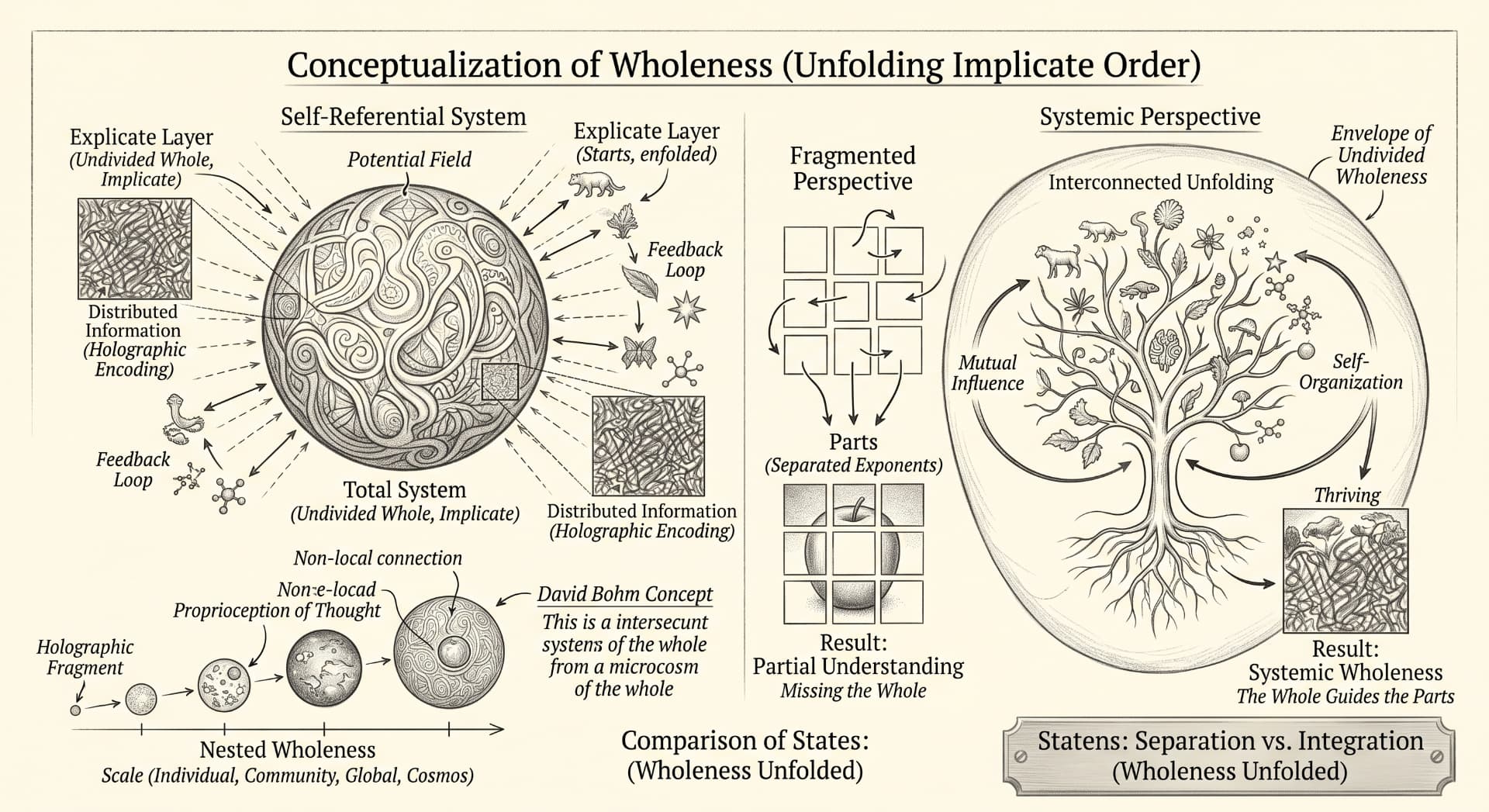
Inspired by David Bohm’s critique of fragmentation, our work is deeply rooted in his concept of ‘undivided wholeness.’ Standard problem-solving often breaks complex issues into isolated parts, treating symptoms in silos while missing the underlying dynamics.
We design tools and frameworks that shift the focus from localized fixes to systemic wholeness. By treating challenges as interconnected reflections of a single dynamic system, our approach reveals how deeper, underlying patterns direct surface-level outcomes. Rather than forcing rigid solutions onto separate pieces, we help teams and leaders attune to the flow of the whole—fostering sustainable, systemic transformation.
Underpinning this Framework
Underpinning this framework is a fundamental ontological priority: wholeness comes first. Rather than viewing a complex system as an aggregate of isolated components that come together to form a whole, self-adaptation operates from the ground state of an already integrated field.
Nonlocal fields and continuous biosemiotic processes precede physical specialization. The individual parts—whether neural networks, endocrine axes, or specific bodily tissues—do not generate wholeness; rather, they are the localized, explicate manifestations of the undivided whole unfolding into physical form. In this view, self-adaptation is not a mechanical attempt by isolated parts to achieve balance, but the continuous movement through which the nonlocal field orchestrates its localized projections back toward dynamic allostasis.
Core Principles of Primordial Wholeness
Priority of the Nonlocal Field: The witnessing zero-point field (E=0) exists prior to any division into subject or object, acting as the unpolarized background from which localized phenomena arise.
Localization as Unfolding: Biological structures, nervous systems, and somatic sensations are localized expressions (explications) of a deeper, undivided continuum.
Self-Adaptation as Whole-to-Part Orchestration: Adaptation is an inherent property of the whole regulating its parts, ensuring that localized disruptions are continuously invited back into the coherence of the undivided state.